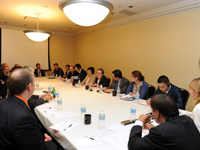
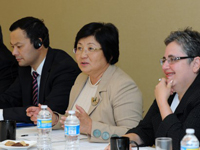
 On September 22, the Carnegie Endowment for International Peace hosted Roza Otunbayeva, President of the Kyrgyz Republic, and several members of her cabinet for a roundtable discussion on the future of democracy in Kyrgyzstan. Michael H. Posner, assistant secretary of State for democracy, human rights and labor, and Eric P. Schwartz, assistant secretary of State for population, refugees and migration, were among the U.S. participants.
Other participants included representatives of leading NGOs, including Human Rights Watch, Freedom House, the Open Society Institute, the National Endowment for Democracy, the National Democratic Institute, and the International Foundation for Electoral Systems. Kori Udovički, UN assistant secretary-general and UNDP regional director for Europe and CIS also attended.
Among the subjects the participants discussed with President Otunbayeva and Jantoro Satybaldiyev, deputy prime minister of the Kyrgyz Republic, were the upcoming parliamentary elections, formation of a coalition government, inter-ethnic relations, and human rights.
International Concerns
 The U.S. officials discussed the U.S. response following June violence in Kyrgyzstan and reaffirmed U.S. commitment to engaging with the Kyrgyz government through the process of rebuilding and reconciliation and beyond. However, continuing inter-ethnic tensions and issues of human rights in Kyrgyzstan remain important areas of concern both for the U.S. government and for the international community.
- Rebuilding. Schwartz praised Kyrgyzstan’s progress in providing temporary shelter for the people displaced by violence in southern Kyrgyzstan, but emphasized the need to shelter displaced persons before winter, and urged the government to continue working with the UNHCR-led Shelter Cluster program to make this possible. He also suggested the government should restore confidence among affected communities by providing firm guarantees that they will have a say in the rebuilding process.
- OSCE involvement. A stable and secure environment is crucial for the reconciliation process to succeed. The United States supports efforts by the Organization for Security and Co-operation in Europe (OSCE) to deploy an advisory police force to work with local law enforcement, said Schwartz.
- International investigation. Representatives of human rights organizations agreed that determining the causes and perpetrators of the June violence through an objective, transparent investigation with international participation is crucial to restoring trust among local communities.
- International involvement. Kyrgyzstan’s neighbors, particularly Russia, Uzbekistan, and Kazakhstan—currently chairman-in-office of the OSCE—have an important role to play in encouraging reconciliation and recovery in the country, Schwartz and Posner agreed.
- Continuing inter-ethnic tensions. The situation in Kyrgyzstan remains volatile, and it would be dangerous to downplay the risk of further ethnic violence, representatives of human rights organizations pointed out. There have been reports of ill-treatment, torture, and arbitrary detention of ethnic Uzbeks. Failure by the government to address abuses will put into question its ability to conduct an unbiased investigation, which could fuel further violence.
- Human rights. Kyrgyzstan’s efforts to re-establish stability must go hand-in-hand with a focus on human rights, the participants agreed. While recognizing the interim government’s attempts to address ongoing abuses in the south, and acknowledging the difficulties of promoting reconciliation, Posner warned that continued abuses undermine Kyrgyzstan’s stability and must be stopped.
Upcoming parliamentary elections
 Although there has been some debate in the international community about whether a parliamentary model is a viable option for Kyrgyzstan, Posner asserted that the United States supports actions by the Kyrgyz government to move toward a parliamentary democracy. The participants emphasized the importance of a fair, transparent election and an inclusive policy toward ethnic minorities, as such policies would help the government’s credibility both domestically and internationally. However, roundtable participants also outlined several concerns regarding the upcoming parliamentary election.
- Voter lists. Voter lists remain a point of contention because voters who lost their documents or were forced to leave their homes as a result of the June violence may effectively be barred from voting.
- Transmission of results. Previously, the transmission of election results was vulnerable to manipulation given lack of familiarity with the electronic system to be used. Measures are being designed to address this issue and prevent potential ballot-box stuffing.
- Dispute mechanisms. Mechanisms have been put in place to handle disputed results and electoral commissions have been formed and trained, but whether they are effective will not be known until the election.
- Forming a coalition. The next challenge after the parliamentary election will be forming a governing coalition, since no party is expected to have a majority in parliament. The success of this process depends on the willingness of party leaders to prioritize the formation of a governing coalition ahead of personal ambition.
The Kyrgyz Leadership Response
- International investigation. Kyrgyzstan’s interim government recognizes the need for and supports an impartial international investigation into the June clashes in the south, President Otunbayeva stated. She argued that it is important to begin the investigation as soon as possible; therefore, a commission under Kimmo Kiljunen of the OSCE Parliamentary Assembly is preferable to a UN-led process, which would take longer.
- Osh. The interim government is focused on restoring stability throughout the south, President Otunbayeva said. However, there remain some obstacles to doing so, which include the persisting influence of the drug trade in Osh.
- Human Rights. Acknowledging the allegations of abuses perpetrated against Uzbeks and pressure from the Uzbek side to address the abuses, President Otunbayeva said there is simultaneously strong pressure on the government from the Kyrgyz side, as families of dozens of missing victims of the June violence demand justice. Uzbeks are also underrepresented in the security forces and the military, which has further contributed to the friction between security forces and Uzbeks.
- Parliamentary model. The proposed switch to a parliamentary system is not Kyrgyzstan’s first experiment with the model, Satybaldiyev said. The country had relative success with the parliamentary model in the early 1990s and the current switch will build on previous experience. The country’s leadership is well aware of the consequences that a failed parliamentary “experiment” would have for the country and is committed to making it work.
- Forming a coalition. Recognizing Kyrgyzstan’s lack of experience with coalition building, President Otunbayeva said the government would welcome technical assistance on forming a coalition. Deputy Prime Minister Satybaldiyev expressed confidence that a coalition would be formed.

- Moving forward. Kyrgyzstan is in the middle of a very difficult process, simultaneously attempting to restore order, smooth tensions, and hold legitimate elections. The government is fully committed to improving the domestic situation and implementing policies that are equitable to all ethnic groups. President Otunbayeva asked Kyrgyzstan’s foreign friends to remain supportive and show patience as the country attempts to move forward during this difficult time.