Carnegie Moscow Center


The mayoral elections in Krasnoturinsk demonstrate the power of Russian civil society, given the right conditions, to overcome the administrative political regime.
Russia’s current ruling elite understands the threat posed by an ethnic project of nation-building and, therefore, seeks to adhere to a supranational concept of Russia as a civilization.
The current political system in Russia is a hybrid of democracy and authoritarianism, or an “overmanaged democracy,” where the elements of authoritarianism dominate democratic ones. The system seems stable on the surface, but is in fact very fragile.
Regional elections in Russia are increasingly more contested, which is more a reflection of the growing number of unaddressed grievances in Russia’s localities than a sign of Russia becoming more democratic.
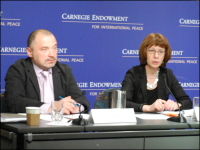
The political system set up under Vladimir Putin's presidency is likely to remain in place for the foreseeable future, despite the impact of the global economic crisis and the aftershocks of the 2008 Georgia conflict.
The past three months have been a turbulent time for the Russian Federation, marked by the Russia-Georgia conflict, global financial crisis, and U.S. presidential elections. Carnegie's Nikolai Petrov explains how the government’s response has illustrated that modernization from above will not occur in Russia.
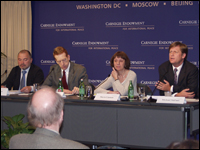
A panel of Carnegie Russia experts present analysis of the current state of Russia's political and economic development and the likelihood of continuity or change in Dmitry Medvedev's first term as president of Russia.

On February 22, Carnegie Moscow Center Scholar-in-Residence Nikolai Petrov discussed Russia's March 2 presidential elections, which are widely expected to usher in the rule of Dmitry Medvedev, President Putin's favored successor.
Features event Video