Carnegie Moscow Center

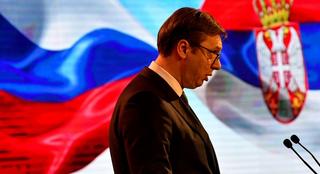
So long as Serbia does not formally recognize Kosovo’s independence, it must rely on Russia’s veto power in the UN Security Council. That dependency gives Russia a nontrivial degree of influence, both in the region and within Serbia itself.

The pro-Russia Party of Socialists of the Republic of Moldova has managed to accumulate an impressive amount of institutional power. But this concentration of power brings not only advantages, but also greater vulnerabilities, especially when there are plenty of destabilizing factors at work, from uncertain gas supplies to mass voting by residents of the breakaway region Transnistria.

This podcast focuses on Russian trade since 2014, when the country started to turn away from the West and increase its exposure to China. Podcast host Alex Gabuev is joined by Tatiana Flegontova and Janis Kluge.

Russia and China’s strategic military cooperation is becoming ever closer. President Putin has announced that Russia is helping China build an early warning system to spot intercontinental ballistic missile launches.

The Russian authorities’ attempts to improve conditions for entrepreneurs are not very predictable, and the new investment regime is constructed in such a way that state control over investment projects will grow, while most state support will go to state capitalists and companies close to them.

Russia is back and here to stay. Others had better accept it and learn to deal with it — without undue expectations, but also without inordinate fear.

Zelensky’s economic path has turned out to be as contradictory as his political path. Various promises ranging from libertarian reforms to classic social populism are hindering the implementation of any meaningful policy.

Russia’s suggestion that Belarus resurrect a 1999 agreement to get compensation for Russia’s oil tax maneuver looks fairly cynical to Minsk. After all, by joining the EEU, in which single markets—including for energy commodities—are supposed to be created between 2018 and 2024, Belarus has already paid for all of its tariff preferences.

We should never forget the benefits that Germany’s reunification brought to the world.

At a time when demand for diversified foreign policy in the South Caucasus is clear, Beijing is building political frameworks that are attractive to countries in the region. In addition, China’s reluctance to get involved in the region’s internal problems makes it a convenient partner for everyone.

Amid the uncertainty over what will happen when Putin steps down in 2024, everyone is striving to claim exclusive functions that could later be required by Putin during the implementation of his plan for the transition of power.

The political framework for cooperation was agreed at the Russia-Africa summit, and with heads of state in attendance and a declaration signed, it was undoubtedly a success for Russia’s Foreign Ministry. As for an institutional economic framework for what is being billed as “Russia’s return to Africa,” it’s still early days.

China has always been considered a convenient partner for Central Asian countries, because it asked for virtually nothing in exchange for investment. But unlike with Western countries, which state the terms of cooperation in advance, with China there are unspoken rules, including a taboo on acknowledging any problems in the relationship.

As long as Serbia lacks a solution to the Kosovo dispute that it can sell both to its international partners and to people at home, and as long as Serbia is denied a clear path to EU integration, it will continue to keep the Russia card up its sleeve.

Russia can’t compete with China in terms of their influence in Africa, so Moscow’s attempts to make inroads there do not alarm Beijing. But as China asserts itself in the role of the major power in Africa, Moscow’s dual influence (such as selling weapons to different sides of a conflict in the same country) could become an impediment to stabilization.

Only the continuation of nuclear arms control can create the political and military conditions for eventual limitations of innovative weapons systems and technologies, as well as for a carefully thought through and phased shift to a multilateral format of nuclear disarmament.

The replacement of Russia’s Human Rights Council head Mikhail Fedotov, who was completely loyal to the authorities, with United Russia party member Valery Fadeyev, determines the council’s status once and for all. It is first and foremost a presidential council, and only then a human rights council.

By cooperating with China in the military sphere, Russia loses virtually nothing in terms of security, while making life difficult for the United States, strengthening its relationship with a key partner, and gaining an economic advantage.

Considering the prospects for trade, Washington shouldn’t yet be concerned by the growth of Russian influence in the Gulf. It’s obvious, however, that Arab countries are being increasingly proactive in diversifying their connections. Moscow is simply making use of this to gain economic and political advantages.

America’s withdrawal creates an opportunity and a challenge for Moscow.