Carnegie Moscow Center

Expectations are running high for major changes in the next U.S. administration's foreign policy, but how much change is likely, and will it be enough to close the gap between America and the world? Top experts from the Carnegie Endowment and elsewhere discussed this question during a two-day conference in Brussels.
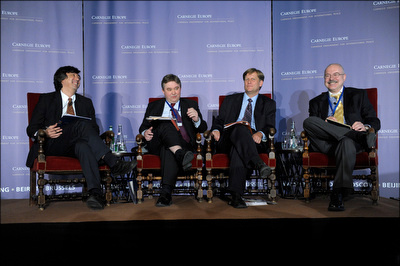
Experts discussed how the West can move forward with its relationship with Russia in the aftermath of the Georgian conflict.
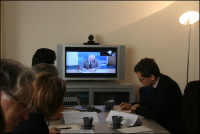
The Russia-Georgia conflict has not only re-defined the balance of power in the Caucasus but also Russia’s relations with the world. To understand what a re-emergent Russia wants, Carnegie Europe has hosted the first of its new ‘Live from…’ video briefing with leading Russian foreign policy expert, Dmitri Trenin.

The Georgian conflict has affected the balance of power between Russia and its neighbors, and raised questions about Russia's regional ambitions. Europe must assert its influence, and play a greater role in the region.
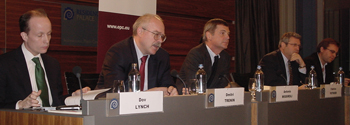
To understand how the West can improve cooperation with Russia, Carnegie Europe and the European Policy Centre co-sponsored an expert panel who suggested the West should begin by focusing on Russia’s economic interests.
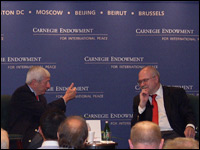
Dmitri Trenin, Deputy Director of the Carnegie Moscow Center, sat down for a discussion with Marvin Kalb of Harvard University's Shorenstein Center to mark the publication of his new book, "Getting Russia Right."
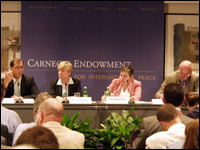
A discussion with Rose Gottemoeller, Alexei Arbatov, and Dmitri Trenin about the future of U.S.-Russian relations.

Analyzing Russia’s foreign policy is a difficult task because of the mixed signals coming from Moscow. In order to disentangle the rhetoric, one needs to start with the issue of the humiliation that Russia ostensibly suffered during the 1990s, which is real in the minds of leaders or at least being used more often as a tool.
Recent events show that the EU-Russia-U.S. strategic triangle has drastically changed. Both the Samara Summit and the G-8 were overshadowed by disagreements between the West and a newly-invigorated and suspicious Russia. The relationship is devoid of trust, and will most likely remain that way through 2008.
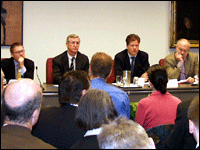
Carnegie hosted a meeting with Bruce Jackson, Project on Transitional Democracies; Charles King, Georgetown University; and Dmitri Trenin, Carnegie Moscow Center.