Carnegie Moscow Center

21st century development strategies cannot continue to overlook the middle class. In advanced economies with democratic systems, the middle class has invented and supported homegrown, market-sustaining institutions. But who in fact are the middle class in developing countries?
Speech by Nancy Birdsall at American University
History of the Nuclear Age Series
Panel discussion with Jaime Serra, former Trade Minister of Mexico; Thea Lee, AFL-CIO representative; Gary Huffbauer, Senior Economist, International Institute for Economics.
Presentations by Michael McFaul, Thomas Graham, Anatol Lieven, and Lilia Shevtsova.
The information revolution marks a fundamental change in the nature of power, the interaction between people and their governments, and the functioning of economies. Despite the revolutionary nature of these changes, there has been little effort within the U.S. government to understand and adapt to their large-scale implications.

The "revolutionary stage" of the post-Soviet era is over. Russia is now facing a second conversion: from the post-Soviet era of transition into a consolidated Russian nation-state. The priority for the Yeltsin regime was to minimize the harm of the fragmentation of the Soviet Union. For Putin, the priority will be to create a new unified national identity.
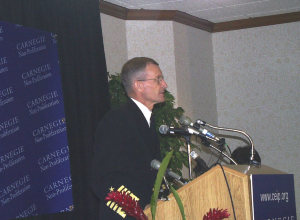
Carnegie Non-Proliferation Conference
Presenter: Dr. Ann Florini, Senior Associate, Carnegie Endowment for International Peace