Carnegie Moscow Center

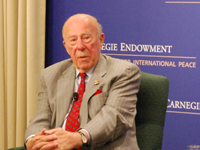
Former Secretary of State George Shultz discussed his views on global disarmament, the wars in Afghanistan and Iraq, the question of America's decline, and the future direction of American foreign policy.

Iran’s nuclear ambitions pose a challenge to international nonproliferation goals. The international community must find a way to ensure Iran’s right to peaceful nuclear technology while preventing Iran from developing atomic weapons.
Climbing oil prices and a stabilizing world economy have raised the Middle East and North Africa's growth prospects, but the outlook remains fraught with uncertainties.
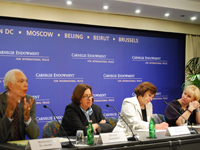
Positive signals from the United States would keep climate change negotiations moving forward, allowing the outcome of Copenhagen to represent a significant milestone on the path to a comprehensive deal.
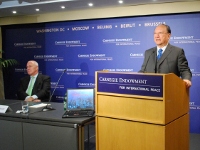
Xu Kuangdi, the former mayor of Shanghai, discussed China’s action on climate change. Efforts to develop circular economies, reduce energy intensity, and increase the share of nuclear and renewable energy are underway.

Kyrgyz Foreign Minister Sarbaev stressed that many of the problems plaguing Afghanistan and Kyrgyzstan, such as security and drug trafficking, are in fact regional problems, and that multilateral negotiations and mutual concessions can help find solutions to these problems.
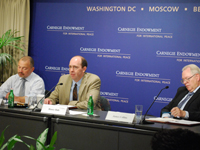
The current political system in Russia is a hybrid of democracy and authoritarianism, or an “overmanaged democracy,” where the elements of authoritarianism dominate democratic ones. The system seems stable on the surface, but is in fact very fragile.
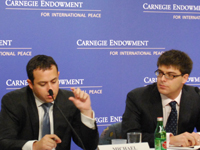
The Nuclear Posture Review will establish U.S. nuclear deterrence policy, strategy, and force posture for the next five to ten years and will provide a basis for the negotiation of a Strategic Arms Reduction Treaty follow-on agreement.
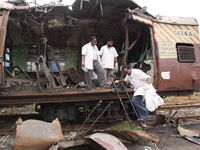
India is home to a number of dissident Hindu extremist groups, who aim to set up parallel regional governments to satisfy their ethno-religious fanaticism, and who are often comparable to radical Islamist groups. These extremists are increasingly resorting to violence as a means for change.
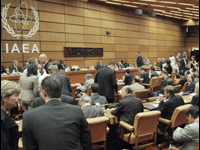
By classifying safeguards non-compliance as violations of the Non-Proliferation Treaty, the upcoming Review Conference will make it much harder to ignore future violations.