Carnegie Moscow Center

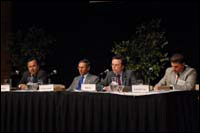
2007 Carnegie International Nonproliferation Conference Panel: European Proposals for Strengthening the Nonproliferation Regime. Chair: Mustafa Kibaroglu, Bilkent University; Martin Briens, Ministry of Foreign Affairs, France; Ambassador Nabil Fahmy, Embassy of the Arab Republic of Egypt to the United States; Pierre Goldschmidt, Carnegie Endowment for International Peace.
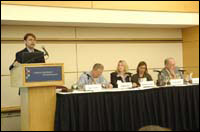
Rules for the Nuclear Renaissance was part of Carnegie's 2007 Nonproliferation Conference. It was chaired by Sharon Squassoni, Carnegie Endowment; Peter Bradford, formerly with the Nuclear Regulatory Commission; Charles Ferguson, Council on Foreign Relations;Corey Hinderstein, Nuclear Threat Initiative; Henry Sokolski, Nonproliferation Policy Education Center.
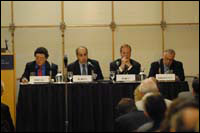
2007 Carnegie International Nonproliferation Conference Panel: Implementing International Measures to Combat Nuclear Terrorism. Chair: William Potter, Monterey Institute of International Studies; Ambassador Peter Burian, Permanent Mission of Slovakia to the United Nations; Igor Khripunov, University of Georgia; William Tobey, U.S. Department of Energy.
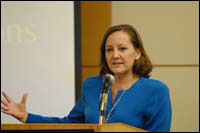
2007 Carnegie International Nonproliferation Conference Panel: Are Sanctions Effective? Chair: Thomas Biersteker, Brown University; Paula DeSutter, U.S. Department of State; Shen Dingli, Fudan University; Skip Fischer, U.S. Senate Committee on Banking, Housing, and Urban Affairs.
On June 23, 2007, the Carnegie Middle East Center and Al-Ahram Center for Political and Strategic Studies held a workshop on the challenge of economic reform in Egypt. The presenters were Othman Mohamed Othman, Minister of Economic Development, Sufyan Alissa, Carnegie Endowment Middle East Center Associate, Ragui Assaad, Population Council, and Sherine El Shawarby, World Bank.
On June 19, the Carnegie Middle East Center hosted an in-house discussion with Timur Goksel, former senior advisor of UNIFIL (United Nations Interim Force in Lebanon), on the challenges and opportunities facing the current UNIFIL II mission. The event was attended by a number of scholars and commentators as well as CMEC staff. The talk was moderated by CMEC director Paul Salem.
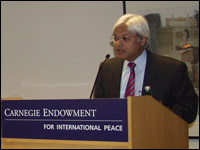
Carnegie launched a new policy brief on China’s ASAT by Senior Associate Ashley J. Tellis. Jessica T. Mathews, Carnegie president, introduced the panel, which featured Dr. Tellis as the presenter, Dr. Michael D. Swaine, Senior Associate in Carnegie’s China program, and Dr. Peter Hays, Senior Policy Analyst with the Science Applications International Corporation, as discussants.
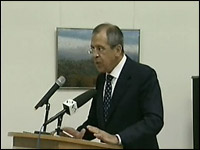
Sergey Lavrov, Minister of Foreign Affairs of the Russian Federation, spoke on cultural, scientific and educational Exchanges between the United States and the Soviet Union/Russia.
Analyzing Russia’s foreign policy is a difficult task because of the mixed signals coming from Moscow. In order to disentangle the rhetoric, one needs to start with the issue of the humiliation that Russia ostensibly suffered during the 1990s, which is real in the minds of leaders or at least being used more often as a tool.
The Carnegie Middle East Center hosted a seminar entitled “Algeria: Elections, Religious Extremism and Reform.” The seminar featured a presentation by Dr. Rachid Tlemcani, Visiting Scholar at Carnegie’s Middle East Center, and a commentary by Dr. Myriam Catusse of the French Institute for Middle Eastern Studies in Beirut. The panel was moderated by CMEC director, Paul Salem.