Carnegie Moscow Center

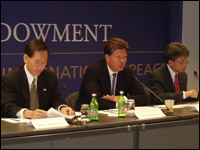
This talk included Bernard Chan and Stephen Cheung with Carnegie Endowment’s Vice President for Studies, Mark Medish, as moderator. C.Y. Leung joined for the Q&A period.

Recent high-level meetings between Putin and Central Asian leaders and the conclusion of several deals that seem to give Russia more power over the latter’s oil and gas have catapulted Russian-Central Asian relations back into the spotlight, and cast them as amicable.

Since 2005, when then-Deputy Secretary of State Robert Zoellick urged China to become a “responsible stakeholder,” policymakers have tried to determine what criteria define responsible stake-holding and whether China is meeting them.

Recent events show that the EU-Russia-U.S. strategic triangle has drastically changed. Both the Samara Summit and the G-8 were overshadowed by disagreements between the West and a newly-invigorated and suspicious Russia. The relationship is devoid of trust, and will most likely remain that way through 2008.
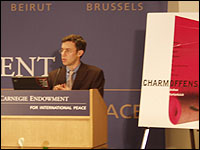
China’s soft power policy is fueled by pragmatism. Ideology has a very limited role.

On June 4, 2007, Amr Hamzawy and Marina Ottaway of the Carnegie Endowment presented their paper “Fighting on Two Fronts: Secular Parties in the Arab World.” Owen Kirby of the Middle East Partnership Initiative served as discussant and Robin Wright of the Washington Post moderated.
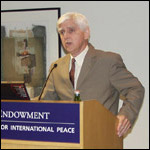
Carnegie Senior Associate Albert Keidel presented his research sponsored by the Ford Foundation on China’s Economic Fluctuations and their Implications for the Rural Economy.
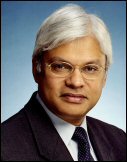
Carnegie Senior Associate Ashley Tellis delivered a talk at an all-day conference on U.S. - India Relations: The Road Ahead, held at the Heritage Foundation on May 23, 2007.
Policy makers search for the right policies to speed development, increase global economic growth, reduce poverty and offer the opportunity of better livelihoods to people in all continents. Carnegie convened a series of discussion to ascertain whether data support particular policy approaches and to point researchers toward the key unanswered questions that might support better policy making.

Trade policy is a major source of friction in the U.S.-China relationship – so much so that the facts are sometimes obscured by rhetoric. Do China’s violations of international trade norms merit a U.S. response, and if so what actions should the U.S take?