Carnegie Moscow Center

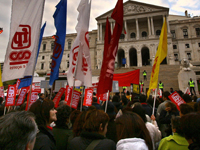
While economic growth and development, social mobilization, and political developments are all independent aspects of national development, they work together in important ways.

Ten years after the beginning of the coalition-led war in Afghanistan, the United States may have to reconsider whether its current strategy is able to achieve its goal of a stable and secure Afghanistan.

China and India have vast energy demands and civil nuclear programs. In the wake of the Fukushima nuclear crisis in Japan, nuclear safety and security will play a major role in both countries’ nuclear evolution and cooperation in the years to come.
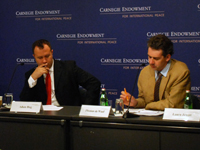
Armenia faces major challenges surrounding democratic development, rule of law, media freedom, corruption, and other human rights issues. What is the impact of international relationships and the Nagorny Karabakh conflict on Armenian politics and society?
China and India possess a number of similarities in nuclear posture. Their advancing missile and missile defense programs, as well as their nuclear modernization programs, have strong implications for strategic stability.
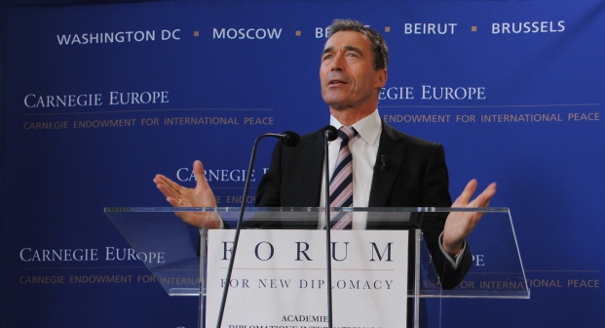
Anders Fogh Rasmussen, Secretary General of NATO, will join Roger Cohen, columnist for the International Herald Tribune, in a conversation on "NATO and the Arab Spring".
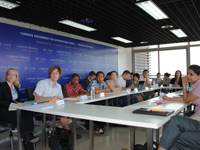
China and India are frequently compared at the economic level, often ignoring the wider spectrum of their regional diplomacy and international engagement.
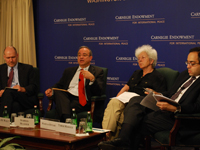
Some leaders have introduced limited concessions in an effort to retain power and cope with popular demands for reform even as a broad spectrum of new political forces is developing across the Arab world.
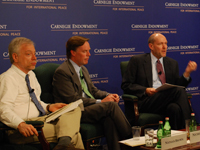
Washington’s response to the Arab Spring was crafted in the context of competing priorities: the challenge of managing simultaneous land wars in Iraq and Afghanistan, an increasingly assertive Iranian regime, international terrorism, climate change, and an economic recession.
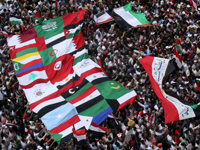
The transformations underway across the Middle East present both an opportunity and a challenge for U.S. policy in the region, as new actors enter the political stage with positions, goals, and political weight that are still difficult to judge.