Carnegie Moscow Center

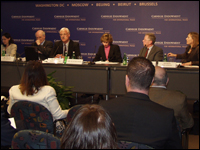
On May 22, Carnegie’s Nonproliferation Program and the Center for Arms Control and Nonproliferation hosted a discussion on the Global Nuclear Energy Partnership (GNEP).
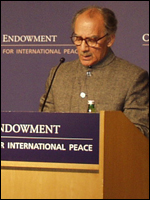
Arun Shourie, former editor of the Indian Express on Tibet and India's responses to Chinese ambitions.

The Carnegie Endowment for International Peace hosted a panel discussion on the current social and political unrest in Egypt.
World Public Opinion conducted a global poll on citizen attitudes toward democracy, which found widespread support for democratic principles. Clear majorities in all countries and 84 percent of respondents overall endorse elections as the preferred means to select leaders.
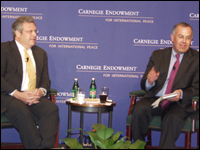
Robert Kagan and The New York Times’ David Brooks discussed Kagan’s new book The Return of History and the End of Dreams.
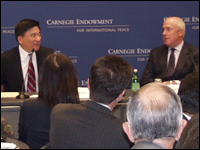
Secretary K.C. Chan of Hong Kong's Financial Services and Treasury speaks on how Hong Kong will continue to serve in its unique role as the bridge between the global financial markets and the booming economy in China.
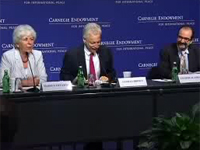
Former Palestinian negotiator Ghaith al-Omari and Carnegie Middle East expert Nathan J. Brown discussed Brown’s new report “Sunset for the Two-State Solution?” in which he argues that the current U.S. approach to the Israeli–Palestinian conflict actually further undermines the chances for a two-state solution.
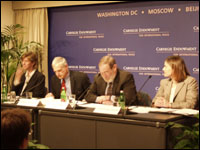
The Carnegie Endowment and the National Committee on North Korea jointly held a discussion on policy options regarding North Korea's nuclear program.
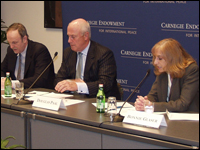
Bonnie Glaser, Senior Associate at the Center for Strategic International Studies, joined Michael Swaine, Senior Associate at Carnegie, to analyze the implications of Taiwan’s newly elected president Ma Ying-Jeou. The newly appointed director of Carnegie's China Program, Douglas Paal, moderated the discussion.
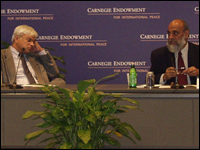
Uday Bhaksar on the legacy of India's nuclear tests.