Carnegie Moscow Center


In this September 28 discussion, Carnegie's Amr Hamzawy and Nathan Brown, professor at George Washington University, argue for shifting the debate about democracy promotion beyond U.S. policy in the region's failed states, while Brookings Institution Senior Fellow Suzanne Maloney warns about the liabilities of direct democracy promotion in Iran.
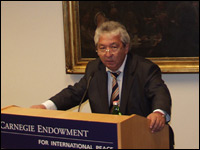
Kyrgyz Foreign Minister Ednan Karabayev sat down with Ambassador James F. Collins, director of the Russia and Eurasia Program, to talk about Kyrgyzstan and its foreign relations.
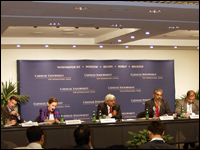
On September 27, the Carnegie Endowment for International Peace and the National Bureau of Asian Research hosted an event launching the publication of Strategic Asia 2007-2008: Domestic Political Change and Grand Strategy. Panelists discussed the meaning of Indian domestic opposition to the US-India civilian nuclear deal, as well as the future of the military regimes in Pakistan and Bangladesh.
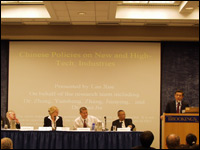
How high – and how fast – is China’s trade moving up the technology ladder? What are the causes and policy implications for China and the U.S. of China’s increasing export sophistication? On September 26, the Carnegie Endowment and the John L. Thornton China Center of the Brookings Institution co-sponsored a discussion with three researchers from the US and China on these controversial topics.
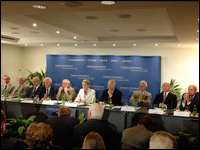
Public Luncheon at the Carnegie Endowment to celebrate 200 Years of U.S.-Russian Diplomatic Relations.
Features event Video

Professor David Shambaugh, founding director of the China Policy Program at George Washington University assessed significance of the17th National Congress of Communist Party of China and its influence on the domestic political development in China. Moderated by Senior Associate Mr. Albert Keidel with comments provided by Dr. Minxin Pei.
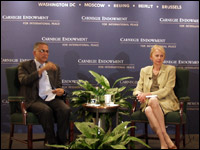
On September 25, 2007, Indian Commerce Secretary Gopal K. Pillai spoke at the Carnegie Endowment on India’s current perspective on the Doha Round.
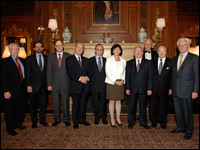
On September 24-25, 2007, Carnegie convened former Russian and American ambassadors to discuss factors that have helped or hindered the bilateral relationship: in short, to examine what has and has not worked.
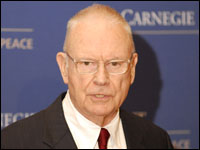
Keynote address by the Honorable Lee H. Hamilton, Director of the Woodrow Wilson International Center for Scholars, at the Carnegie celebration of 200 Years of U.S.-Russian Diplomatic Relations.
Features event Video

On September 20, 2007, the Carnegie Endowment hosted a discussion about the impact of core labor standards on development. Speakers from the International Labor Office and the office of the United States Trade Representative evaluated the outcomes of programs to implement the standards. Carnegie's Sandra Polaski moderated the event.