Carnegie Moscow Center

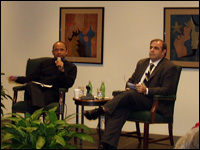
Pramit Pal Chaudhuri spoke at the Carnegie Endowment on December 5, 2007 to present India's menu of energy options.
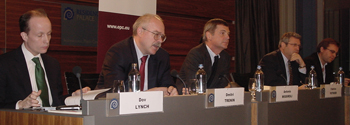
To understand how the West can improve cooperation with Russia, Carnegie Europe and the European Policy Centre co-sponsored an expert panel who suggested the West should begin by focusing on Russia’s economic interests.
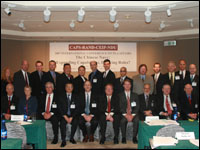
This year's International Conference on PLA Affairs, held in Taipei, Taiwan from November 29th to December 1st, focused on the theme of "The Chinese Navy: Expanding Capabilities, Evolving Roles?" An edited volume derived from the conference papers will be published in 2008.
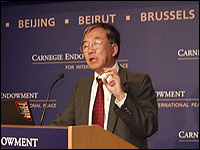
People in Asia embraces democracy as a principal but have a very different understanding of what it looks like compared to citizens in the West.
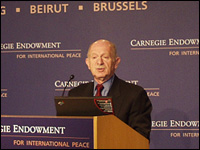
Mark Schneider, Senior Vice President at the International Crisis Group, says Pakistani President Pervez Musharraf's declaration of emergency violates the constitution and moves the country further from democracy. Plus, he's not even that good of a partner in the war on terror. The US ought to impose some conditions on Musharraf and support Pakistan's civil society and democratic institutions.
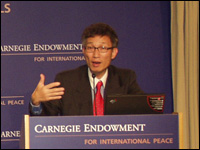
Director of China Program Minxin Pei presented his latest policy brief Corruption Threatens China's Future in a seminar hosted by Carnegie Endowment on November 20, 2007
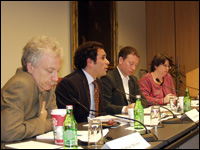
Amr Hamzawy and Nathan Brown from the Carnegie Endowment, and Marc Lynch of George Washington University interpreted and analyzed the Muslim Brotherhood’s new party platform in Egypt.
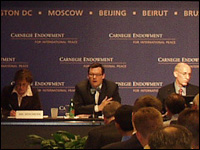
Gregory Kulacki and Jeffrey Lewis argued in a joint presentation that the common arguments about China’s anti-satellite test—that the test was a shot across the bow of American space superiority or an attempt to force the U.S. into negotiations to restrict the development of space weaponry—are based on limited information and unreliable sources.
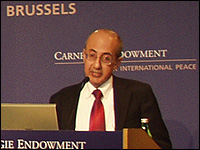
Rafiq Dossani, Senior Research Scholar at the Shorenstein Asia-Pacific Research Center of Stanford University, acknowleged that by the measure of economic growth and international prestige, India is unquestionably “arriving” as a major global power. But when one considers other indicators—such as India’s non-market sector, widespread poverty, and social democracy—India’s arrival is not so obvious.
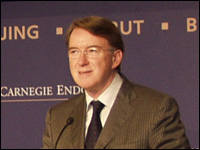
In a speech at the Carnegie Endowment, European Commissioner for Trade Peter Mandelson argued that the European Union and the United States must use their collective economic weight to underwrite the openness of the global economy as it adjusts to the rise of new economic powers and greater global flows of investment.