Carnegie Moscow Center

Regional experts discuss the political and economic effects of the tumultuous and costly U.S.-led occupation in Iraq on the wider region. The meeting also analyzed how regional powers could help ameliorate the deteriorating situation.

Though China’s long-term strategic ambitions are unknown and unpredictable, it seems certain that Chinese leadership seeks a preponderant role in Asia. But will Beijing try to reduce or eliminate the United States' influence in the region?
The Middle East Program and the Istituto Affari Internazionali hosted a conference on Islamist movements, focusing on the divide between Western theories and Islamist thought. The discussion touched on a range of issues, including the role of religion in politics, the significance of sharia for the political/legal system, individual rights and freedoms, pluralism, the rights of minorities.
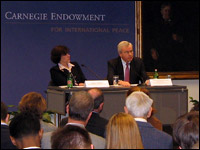
John Holmes, United Nations Under-Secretary-General for Humanitarian Affairs, discussed his recent trip to Darfur, Sudan, Chad, and the Central African Republic in an event at the Carnegie Endowment.
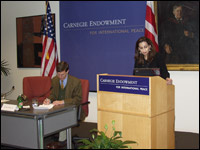
On April 16, 2007, the Carnegie Endowment hosted Pakistan People’s Party Representative Sherry Rehman, who spoke on “Pakistan Today: Policy Challenges and U.S. Engagement.” George Perkovich moderated the event.
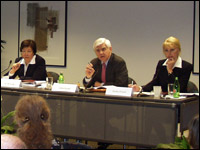
On Tuesday, April 17th Sandra Polaski, Director of the Carnegie Endowment’s Trade, Equity and Development Project, and Li Shantong, Senior Research Fellow at the Development Research Center of the State Council of the People’s Republic of China presented results from their recently released study “China’s Economic Prospects 2006 – 2020.”
On April 12, 2007, the Carnegie Endowment for International Peace hosted a meeting entitled "Developments in the South Caucasus and Caspian: A Georgian Perspective" with The Honorable Zurab Nogaideli, Prime Minister of Georgia. Mark Medish, Vice President for Studies at the Carnegie Endowment, chaired the discussion. A summary of his remarks are provided below.
Carnegie's Nikolai Petrov and Masha Lipman, discuss the future of democracy in Russia.
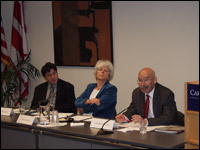
On March 29, 2007, Rachid Tlemcani, visiting scholar at the Carnegie Middle East Center, argued that since the civil war of the 1990s, violence in Algeria has decreased and the economic and political situations are stabilizing. Daniel Brumberg, professor of government at Georgetown, served as discussant and Marina Ottaway, Carnegie Endowment, moderated.
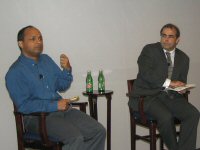
On March 28, 2007, the Carnegie Endowment hosted Pramit Pal Chaudhuri, Bernard Schwartz Fellow at the Asia Society, New York, and Foreign Editor of The Hindustan Times. His talk, entitled “India: The Decisive Decade,” was moderated by Visiting Scholar Frederic Grare.