Carnegie Moscow Center

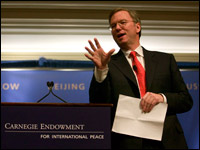
Carnegie launches its New Vision. Building on the strength of its century-long practice of changing as global circumstances change, the Carnegie Endowment for International Peace is undertaking a fundamental redefinition of its role and mission. Carnegie aims to transform itself from a think tank on international issues to the first truly multinational—ultimately global—think tank.
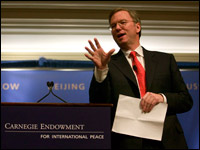
The Carnegie Endowment launches it new vision initiative to pioneer the first global thinktank with integrated offices throughout the world.

The only effective economic reforms in the Ukraine will come through the free market system. Increasing the value of its workforce and improving the pensioner system should not come through populist measures.
There are not necessarily preconditions that must be in place before a country attempts democratization, argues Thomas Carothers. Francis Fukuyama and Jack Snyder joined Carothers to debate the sequencing fallacy.
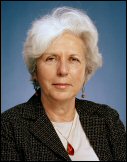
On January 24, 2007, the Beirut-based Center for Arab Unity Studies (CAUS) hosted prominent Lebanese figures for a seminar on Washington's new policies toward the Middle East, featuring a presentation by Carnegie’s Director of the Middle East Program, Marina Ottaway.
On January 19, 2007, Carnegie hosted Dr. Rola Dashti of the Kuwait Economic Society, who discussed Arab civil society reform and the need for grassroots constituency-building.
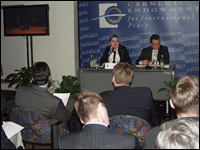
This event featured presentations by Turkmenistan's two major opposition leaders living abroad, Nurmuhammed Khanamov and Khudayberdy Orazov, speaking and participating in a discussion via live video-conference from Berlin. Carnegie Endowment Senior Associate Martha Brill Olcott moderated the event.
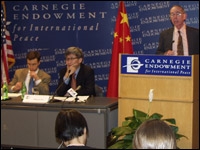
On December 12, 2006, the Carnegie Endowment for International Peace sponsored an event with Visiting Scholar Joshua Kurlantzick and former ambassador to Burkina Faso and Ethiopia Dr. David Shinn. This event was organized in coordination with the release of Kurlantzick’s Policy Outlook, “Beijing Safari” and was moderated by Carnegie Senior Associate Minxin Pei.

Many analysts predict that China’s economy, even if its growth trajectory gradually slows, will be larger than the U.S. economy before the middle of the 21st century. But without domestic reform, will China's economy unravel before overtaking the U.S.?
At an event to launch Confronting the Weakest Link, Thomas Carothers was joined by discussants Ivan Doherty, Gerald Hyman, and Judy Van Rest. The session was moderated by Jennifer Windsor.
Features event audio and video