Carnegie Moscow Center

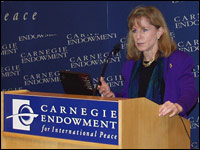
Dr. Amy Smithson explains his finding on the extent of the biological weapons threat, the available policy options, and finally the U.S. government’s performance and future priorities for biological weapons nonproliferation.
Carnegie hosted a seminar on Russia's accession to the WTO, including a presentation by AUSTR Dorothy Dwoskin on the negotiation of the U.S.-Russia bilateral agreement.
Features event audio and video
After the collapse of the Soviet Union, religion, in particular Islam, has come to play an important role in Russia’s regions. Two different processes characterize religion and society in Russia: on one level, there has been a desecularization of the elite, and on another, there have been significant changes within Russian Islam.
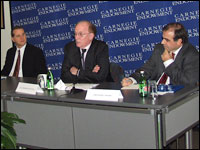
The discussion on Afghanistan should shift from the question of whether NATO should have gone into the country to what it would mean for both NATO and the international community to fail this mission.
Carnegies's third meeting dealing with political reform in the Gulf Cooperation Council (GCC) countries featured researchers from across the region. The discussion focused on various drivers of political reform: political actors; new political institutions; economic transformation; and the impact of new ideas and debates to which the region's population is increasingly exposed through mass media.
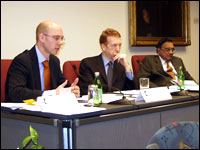
Carnegie hosted Jeroen de Zeeuw and Krishna Kumar, who presented thier new book, Promoting Democracy in Postconflict Societies on November 9, 2006. Thomas Carothers moderated the event.
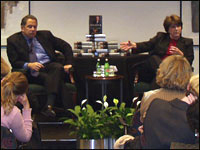
Former Carnegie scholar Karen DeYoung discusses her book, Soldier: The Life of Colin Powell.
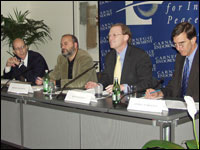
Discussants addressed the challenges posed by globalization and the policies and institutions that will be needed to overcome them.
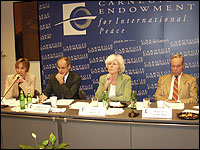
Morocco exemplifies an extreme case of top-down reform, because reform comes from the king without much involvement by the opposition. In a discussion hosted by the Carnegie Endowment, Marina Ottaway presented her paper Morocco: From Top-Down Reform to Democratic Transition?, which argues that while many changes have taken place in Morocco, none can be described as democratic.