Carnegie Moscow Center

Discussants examine recent developments in a number of Gulf countries and analyze their significance in the overall process of political reform in the Gulf region. The workshop looked at the process of political change in specific countries, focusing on the domestic factors driving the reform process, how far the transformation has progressed, and how it is likely to unfold in the future.
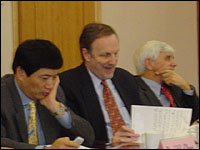
Carnegie's Minxin Pei, Michael Swaine, and Albert Keidel participated in a conference in Beijing jointly sponsored by the Carnegie Endowment and the China Reform Forum.
On November 12-13, The Carnegie Endowment for International Peace and the Italian Istituto Affari Internazionali, in partnership with the German Herbert-Quandt-Stiftung, organized a two-day workshop in Rome to discuss the policy preferences and reform strategies of non-violent Islamic movements in different Arab countries.
Global energy companies still want to go into Russia, even if the conditions are not what they had once hoped. Most countries don’t sell majority shares in big fields. So Russia is becoming a more normal energy-producing country.
The 2005 Carnegie International Non-Proliferation Conference attracted over 800 experts, officials, and journalists from around the world. The conference provided an open forum for informed discussion on the most pressing nonproliferation issues facing the world today, including Iran, North Korea, and the nuclear fuel cycle. Visit our conference website to catch up on anything you may have missed, including video and audio, transcripts, presentations, guest bloggers and photo galleries of this amazing two-day event.
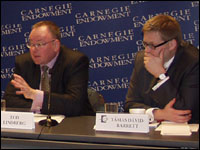
On November 3, the Democracy and Rule of Law Project and the Central European University co-sponsored a panel debate on how significant anti-Americanism actually is to American foreign policy.
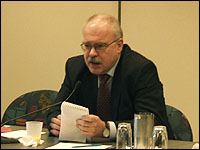
Dmitri Trenin, of the Carnegie Moscow Center, discussed his recent policy brief with a group of experts.
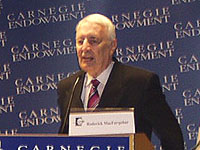
On November 2, the China Program and China Vitae co-sponsored a day-long conference on Chinese leadership, with panels on the tools of leadership analysis, leadership similarities and differences on foreign policy, and leadership unity and conflict on domestic issues. Roderick MacFarquhar of Harvard University gave the keynote address.
Russian foreign policy is now entering a fourth stage. The first three were associated with Foreign Minister Kozyrev, Foreign Minister Primakov, and Putin during his first term. In the first two stages Russia's foreign policy was reactive. In the third Russian foreign policy became more active. Now Putin faces a choice between realpolitik and post-World War II international security cooperation.
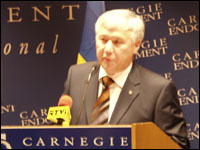
Yuriy Yekhanurov, Prime Minister of Ukraine, discussed his government's economic plans and Ukraine's integration into the EU, NATO, and the WTO.