Carnegie Moscow Center

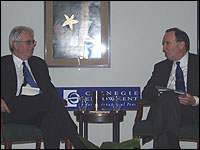
Brazil's Ambassador to the WTO discussed liberalization of agriculture, industry and services in depth at the Carnegie Endowment.
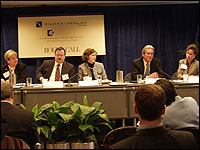
The year 2006 will be a watershed for U.S. agriculture, with impending expiration of "fast track," a push to finish a WTO Doha agreement, and drafting of the 2007 Farm Bill, which must conform to WTO agreements. Is U.S. agriculture ready for these challenges? U.S. and foreign leaders and experts discussed these issues in the 2006 Policy Forum.
Ukrainian Interior Minister Yurii Lutsenko discussed his government's efforts against corruption and the political prospects of democratic parties in upcoming parliamentary elections.
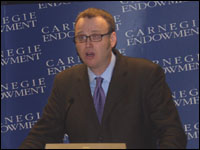
Joshua Muldavin, of Sarah Lawrence College, argued that China's rapid growth during the past two and a half decades has been built upon a base of environmental destruction and social decay.
Three speakers, all of whom were in Palestine to observe the recent elections there, discussed this dramatic turning point. Having demanded clean elections, the international commumity is now forced to deal with the consequences. As the experts discussed, Hamas' new position of power will have a range of implications for Palestine's domestic and foreign affairs.
Discussion and launch of Promoting the Rule of Law Abroad: In Search of Knowledge, edited by Thomas Carothers.
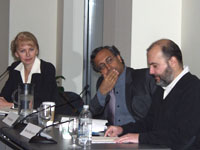
Despite the promises made by globalization, in the last twenty years the world’s poorest countries have fallen further behind the rich. At a Carnegie event, Branko Milanovic and Sanjay Reddy of Columbia University discussed why the poorest countries have not caught up.
Frédéric Grare presented his paper, “Pakistan: The Resurgence of Baluch Nationalism,” (published by the Carnegie Endowment in January 2006) which analyzes the conflict in Baluchistan, a Pakistani province straddling Pakistan, Iran, and Afghanistan
Nonproliferation experts Goldschmidt and Perkovich discuss next steps and options for UN Security Council.
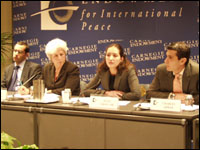
The main obstacle to reform is the lack of any coherent central authority in Lebanon that has institutionalized decision-making mechanisms. The manner in which power is divided among the various sects results in de facto mini-states responsible for all the needs of their constituents, which leads to political and administrative paralysis.