Carnegie Moscow Center

Campaigning has begun for Myanmar’s first general election since the end of direct military rule. But recent events underscore the influential role of the military in the run-up to the election and raise questions about civil-military relations in the country’s transition to democracy.
The current downturn in U.S.-Russian relations can be understood as a new Cold War. A new long-term strategic vision is needed to guide the two countries through this challenging period.
U.S. economic policy in India needs to be reconciled with its strategic policy in Asia.
Both India and the United States should address low-hanging fruit—dispute resolution, intellectual property, and taxation—to facilitate immediate trade gains for both economies.
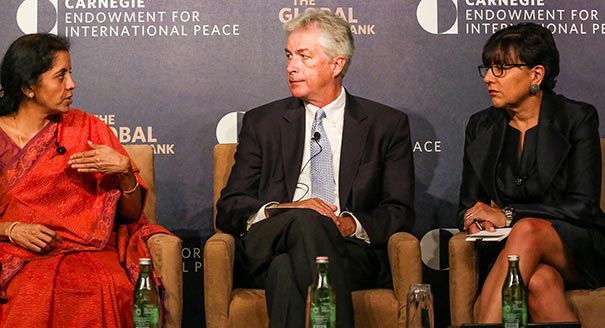
A conversation with U.S. Secretary of Commerce Penny Pritzker and Indian Minister of State (Independent Charge) for Commerce and Industry Nirmala Sitharaman.
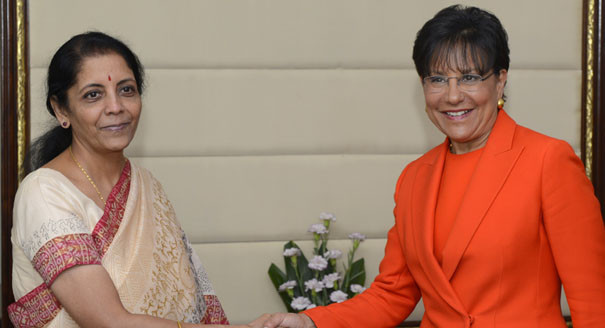
To initiate an exciting week of efforts between the United States and India to strengthen bilateral relations, Carnegie hosted a half-day conference to discuss the prospects for transformed economic ties between the two countries.
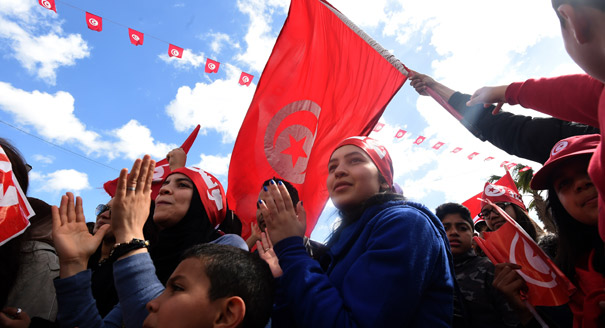
Almost five years after the outbreak of the Arab Spring, countries across North Africa are experiencing different phases of political change.

Shia-Sunni sectarianism is one of the factors driving instability in the Middle East.
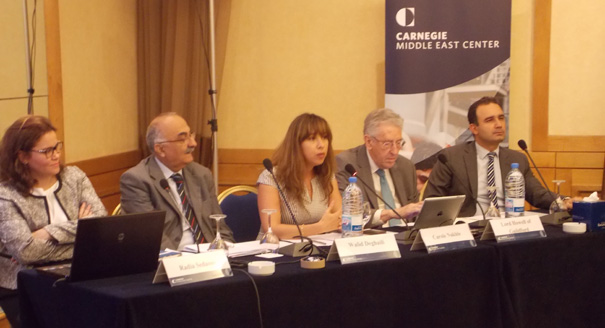
A panel of international and regional energy experts discussed whether the Middle East and North Africa can be a major oil- and gas-producing (and consuming) region, while also committing to reducing carbon emissions.
As a security vacuum in Europe grows, a wider, strategic question remains unanswered: Who is responsible for keeping Europe safe and free, and at what cost?