Carnegie Moscow Center

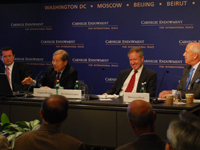
While China remains an engine of growth in an unsettled global economy, it also faces many challenges, including high inflation, the potential of a housing market bubble, and volatile global liquidity conditions.
As the effects of climate change continue to impact daily life, what are the opportunities for leading carbon emitting countries to improve their energy efficiency?

The world's major vendor companies of civilian nuclear power plants have agreed to apply a common set of principles in their exporting decisions and practices.
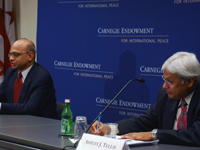
China's unique status as the source of transboundary river flows to the largest number of countries in the world and its water disputes with many of those countries has serious implications for India.
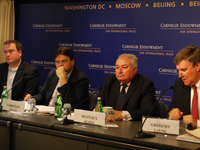
Ten years after the September 11 attacks caused tensions between the United States and Saudi Arabia, the two countries are facing a crisis of relations in the wake of the Arab Spring.
Ten years after the attacks on September 11, the United States and Pakistan have little to show for the strategic cooperation they proclaimed in the aftermath of the attacks.

Dialogue, education, and an accepted role for religion in society are critical to countering the possible threat that religious radicalization could pose to state security in Central Asia.
While dialogue between the European Union and Russia on Moscow’s foreign policy typically focuses on hard power topics, the West’s expansion has prompted the Kremlin to develop its soft power toward post-Soviet states.
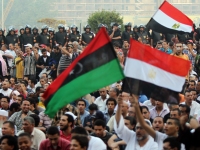
There is an overall lack of structure in the movements that made up the Arab Spring, or the “Islamic Spring,” but Islamist groups are generally better organized than the other opposition groups that made the “Islamic Spring” possible.
In June, President Obama described a planned “transition period” for Afghanistan in 2014, involving an Afghan-led effort aimed at maintaining domestic stability with international support.