Carnegie Moscow Center

Chinese citizens are using the internet as a source of social discourse at exponential rates. It is unclear whether this growing phenomenon will result in “cyber-ocracy” or “cyber-tarianism”.
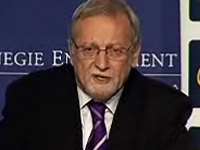
The co-chairs of the International Commission on Nuclear Nonproliferation and Disarmament, former Australian Foreign Minister Gareth Evans and former Japanese Foreign Minister Yoriko Kawaguchi, gave a briefing at the Carnegie Endowment on the Commission’s progress and future direction following meetings with senior officials in the Obama administration.
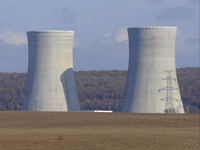
Workshop co-hosted by the Nonproliferation Policy Education Center and the Carnegie Endowment's Nonproliferation Program.
The growing strength and assertiveness of the Kurdistan Regional Government (KRG) has alarmed Iraq’s neighbors and the Baghdad government. If ignored or badly handled, Kurdish aspirations have the potential to ignite violence and instability in Iraq and the region at a particularly delicate time.
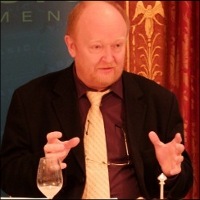
Alexey Malashenko and Johannes Regenbrecht gave a comparative assessment of the European and Russian strategies in Central Asia.

How deep will the Russian economic crisis be and how will it affect the country's economic and political development? What are the paths towards the country's modernization? What are the underlying causes for the rift in the U.S.-Russia relationship and how can the West effectively reengage with Moscow?
To highlight the divergent opinions on Russia's future path, possible Russian responses to the new U.S. administration and the likely direction of the relationship, on February 6, 2009, the Carnegie Endowment for International Peace (Washington, DC) hosted a spirited discussion titled “ Is Russia Ready for Change? ” with Dmitri Trenin and Lilia Shevtsova (Carnegie Moscow Center), joined by Donald Jensen (Johns Hopkins University).
James Collins moderated the event.
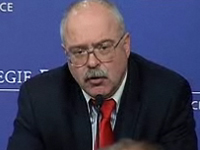
The international financial crisis may help sustain Russia's political and economic system in the short-term or it may usher in rapid change. Regardless, it is unsustainable in the long run.
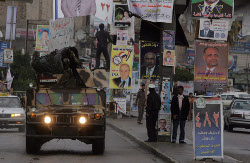
The recent crisis in Gaza, upcoming Israeli elections, and Iraq’s provincial elections are reshaping the political landscape in the Middle East and providing new opportunities for Europe and the United States to play a constructive role.
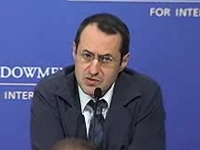
U.S. strategy in Afghanistan should concentrate on strengthening the central government and institutions to create conditions necessary for foreign troop withdrawal. The U.S. could then focus on the central security problem in the region: al-Qaeda and the instability in Pakistan.
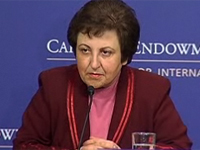
Nobel Peace Prize laureate Shirin Ebadi, a renowned advocate for democracy and human rights in Iran, discusses the state of civil society and ways the U.S. can engage Iran.