Carnegie Moscow Center

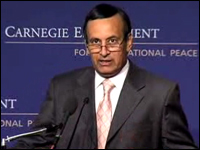
The process of political evolution towards democracy needs to be supported regardless of the leaders it produces. The next U.S. president must pursue a balanced strategy toward Pakistan that simultaneously strengthens the civilian government—the best hope for Pakistan’s long-term stability—without alienating the Pakistani army.
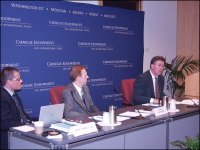
In response to political parties that are institutionally weak, sectarian, poorly inclusive, and ideologically incoherent, new democracies are increasingly attempting to use institutional incentives and constraints to stimulate the development of cohesive and inclusive parties.
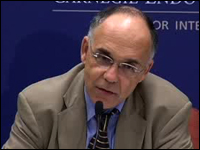
Turkey’s constitutional crisis – which nearly led to the banning of the ruling Justice and Development Party (AKP) – is not over yet. Henri Barkey and Ian Lesser argue the country has yet to fully recover, and the AKP needs to implement a set of changes to the party’s hierarchy and political agenda in order to avoid another crisis.
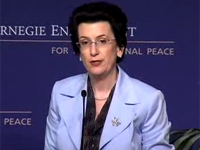
H.E. Nino Burjanadze, former speaker of the Georgian parliament, warned that the current Russian show of force was more about Russia’s attempt to establish a new regional order rather than support the independence efforts of South Ossetia and Abkhazia.
The Strategic Arms Reduction Treaty (START), an integral part of the bilateral nuclear relationship between Russia and the United States, will expire in December 2009. To discuss what should replace the treaty, the Carnegie Moscow Center hosted Ambassador Linton Brooks, the United States’ chief negotiator during the 1991 START talks.

On September 4, 2008, former speaker of the Georgian parliament Nino Burjanadze spoke at the Carnegie Endowment for International Peace , Washington, DC, on the Russia-Georgia conflict.
Burjanadze highlighted the causes of the conflict, the next steps that the international community should take, U.S. policy towards Georgia, including during the next administration, Georgian prospects for NATO accession, democracy in Georgia, Georgian actions prior to the conflict, and the future of Russian-Georgian relations. The former speaker of the Georgian parliament insisted on the need of international support and criticized Russia, but noted that isolating Russia may not be the best solution and attempting diplomacy may still be possible at this moment.
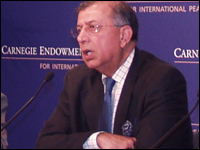
The Army is the most powerful political party in Pakistan. With an acceptance rate similar to Ivy League institutions (one out of ten applicants), the army remains the most prestigious institution in Pakistan. Pakistan spends 3.4% of its GDP on the military, compared to 1.2% for the social sector; a stark reminder of its economic footprint in a country still struggling with poverty.
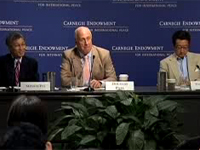
The Beijing Olympics mark China’s emergence as a global leader, but present risks that could mar its reputation. Risks include logistical organization, pollution, security, and political protests.
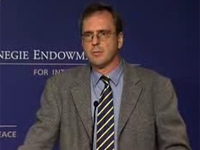
The international community and the Gulf states are not providing sufficient funding or accepting enough Iraqi refugees. The current situation is highly unstable and fragile, and very little progress can be expected without Iran’s and Syria’s involvement. No significant return of refugees can be expected in the next ten years.
The slow down in the spread of democracy can be attributed to high oil prices, Islamic extremism in some democratic countries, and the success of the authoritarian model of economic and political development in China.