Carnegie Moscow Center

Saudi Arabia’s increasing use of unconventional, “soft” measures to combat violent extremism is bearing positive results, especially its rehabilitation program, which officials claim enjoys an 80-90% success rate. The Saudi approach is now serving as a model for the US military as it deals with insurgent detainees in Iraq.
The status of Golan Heights remains the last major disputed land issue between Israel and its neighbors, outside of its conflict with the Palestinians. Indirect talks between Syria and Israel have set the stage for starting meaningful negotiations, but their success depends heavily on U.S. direct involvement.
With U.S.-Russia relations at a crossroads, several former ambassadors to Russia and the United States met to discuss how the two nations might move forward. In the near term they urged both nations to exercise restraint and cool their rhetorical exchanges. Looking to the longer term they urged the creation of an improved framework for dialogue.
The abolition of nuclear weapons is rising on the international agenda, made clear in statements by U.S. presidential candidates, British and Indian leaders, and a campaign led by former U.S. officials. George Perkovich and Sir Michael Quinlan explore whether and how the elimination of all nuclear arsenals could be verified and enforced.
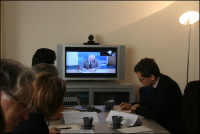
The Russia-Georgia conflict has not only re-defined the balance of power in the Caucasus but also Russia’s relations with the world. To understand what a re-emergent Russia wants, Carnegie Europe has hosted the first of its new ‘Live from…’ video briefing with leading Russian foreign policy expert, Dmitri Trenin.

The Georgian conflict has affected the balance of power between Russia and its neighbors, and raised questions about Russia's regional ambitions. Europe must assert its influence, and play a greater role in the region.
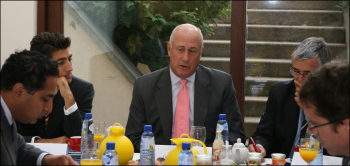
The rise of China as a major economic, cultural, and military force in has fundamentally altered the balance of power in the Asia-Pacific region. Doug Paal from the Carnegie Endowment, and Geoffry Barret from the European Commission, discussed how the U.S. and the EU should respond to this new dynamic.
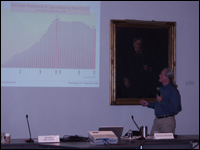
In this event hosted by the Carnegie Endowment's Nonproliferation Program, Mycle Schneider, author of the 2007 World Nuclear Industry Status Report, questions whether the world civilian nuclear industry is capable of achieving a "nuclear renaissance," given its declining share of electricity market, recent construction problems, and education crisis.
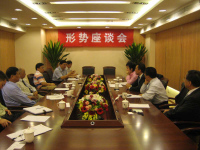
In the midst of a wrenching global financial crisis, business and academic experts from around the world met in Beijing to discuss the causes and implications of the crisis. Although there was disagreement over the severity of the crisis, all participants agreed that it marks the end of the unbridled free-market economy in the U.S.
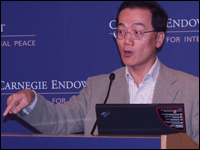
China is shifting its focus from growth to the broader goal of development, which includes a wide range of social and economic policy objectives. To examine the nature and impact of that transition, Carnegie hosted an event with KC Kwok, chief government economist of China's Hong Kong Special Administrative Region. Albert Keidel, senior associate at Carnegie, moderated the discussion.