Carnegie Moscow Center

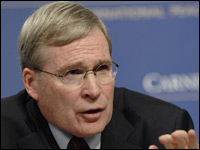
Assistant to the President for National Security Affairs Stephen J. Hadley discussed the Bush administration's efforts to promote economic growth and disease prevention in Africa and commented on the president's upcoming travels to Africa and his Smart Development Policy.
China Program hosted a seminar to discuss China's latest agriculture policy. Moderated by Senior Associate Albert Keidel, this event featured guest speaker Hu Binliang from Chinese Academy of Social Sciences.
Contemporary discourse on democratic transformation in the Arab world often lacks a critical assessment of the kind of progress that is taking place on the ground. Marina Ottaway and Julia Choucair-Vizoso launched their new book Beyond the Façade: Political Reform in the Arab World, a critical assessment of political reform in the Arab world based on ten case studies.
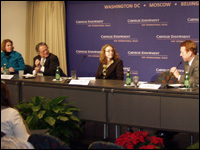
On January 25, Carnegie Senior Associate Ashley J. Tellis presented the findings of his Carnegie Report, Pakistan and the War on Terror: Conflicted Goals, Compromised Performance, at the Royal United Services Institute (RUSI) in London. Tellis and Carnegie Visiting Scholar Frederic Grare provided first-hand commentary following President Musharraf's keynote speech at RUSI.
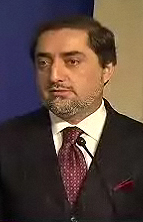
On January 18, 2008, Afghanistan's former Minister of Foreign Affairs, Abdullah Abdullah discussed the problems facing Afghanistan and possible solutions. The discussion was moderated by Carnegie's Jessica T. Mathews.
China and India’s emergence as global powers is unprecedented in modern history. Sino-Indian bilateral relations are defined by a complex balance of competition and cooperation - co-engagement.
Carnegie's Marina Ottaway and Michele Dunne presented the findings of their recent Carnegie Paper on December 18. J. Scott Carpenter from The Washington Institute participated in the panel as a discussant and Carnegie's Thomas Carothers moderated the event. The discussion focused on identifying the challenges facing elite-driven reform in the Arab world.
Pakistan’s has given a lackluster performance in counterterrorism because it has been unmotivated, but also because of extraneous factors beyond the immediate control of Islamabad, said Ashley J. Tellis at an event launching his new policy brief.
Since the pursuit of economic development and deepening democracy are complementary goals, there should be a long-term processes of democratic development that involves incentives for democratic reform and putting existing domestic democratic institutions to work.