Carnegie Moscow Center

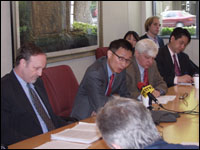
China experts Minxin Pei, Michael Swaine, and Albert Keidel discuss U.S.-China relations and the impact of Hu Jintao's visit.
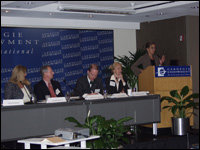
Development finance institutions that lend to private firms in developing countries have started to require borrowers to adhere to national and international labor standards in their operations. Carnegie and the ILO brought together practitioners to discuss the process of implementing labor standards and to share best practices to achieve success on the ground.

Clifford Gaddy and Barry Ickes discussed the economic significance of resource rents, their distribution, and their place in the Russian political system.
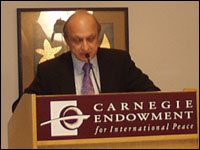
Vahram Nercissiantz, Chief Economic Advisor to the President of Armenia, discussed his government's economic program.
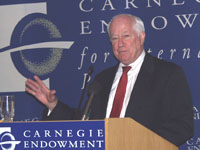
Congressman Kolbe, chairman of the Foreign Operations Subcommittee and member of Homeland Security Subcommittee, discussed the Dubai Ports World controversy.
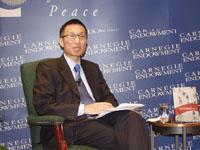
Carnegie's Minxin Pei spoke at the launch of his new book, China's Trapped Transition: The Limits of Developmental Autocracy (Harvard University Press, 2006). Carnegie President Jessica Tuchman Mathews moderated the discussion.
Political reform in Syria is influenced not only by domestic forces but also by regional developments and the policies of Western countries, particularly the United States. At present, those policies are not helping the cause of political reform.
Islam has long been a driving force in world politics, but the bulk of its influence was localized. Now, its reach has expanded into the western world and has truly changed the political climate in many western states, creating multiple crises of identity, politics, values and security in Europe.

Islamist movements have become major political actors in the Middle East. Nathan Brown, Amr Hamzawy and Marina Ottaway discussed their new study, Islamist Movements and the Democratic Process in the Arab World: Exploring the Gray Zones, which examines the “gray zones”—areas of ambiguity—in their rhetoric and thought.