Carnegie Moscow Center

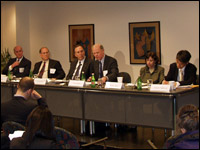
The United States and Japan have one of the most important relationships in the world, based on shared values, the size of their economies, and their technological sophistication. New cooperation between the U.S. and Japan will benefit not only the two countries but also the whole Asia-Pacific region, possibly providing the building blocks for an Asia-Pacific partnership.
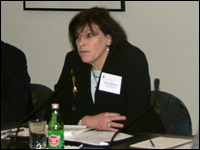
Discussants examine the ongoing global power shift toward Asia and its impact on the international system.
Marking the launch of its events series, the Carnegie Middle East Center in Beirut hosted a roundtable discussion on Evaluating Economic Reform in the Arab World on Thursday, February 15, 2007.
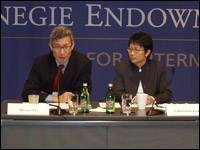
The leading voice in public policy in Hong Kong, Christine Loh, spoke at Carnegie on February 13, 2007 about Hong Kong politics. Carnegie Senior Associate Minxin Pei moderated the discussion.
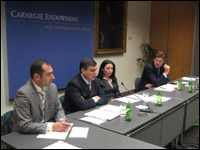
On February 13, 2007, former Armenian Prime Minister and opposition leader Aram Sarkissian discussed his country's upcoming parliamentary election.
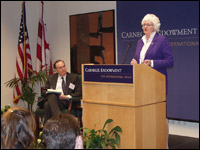
EU Commissioner for Agriculture, Mariann Fischer Boel, explains how the role of agriculture in multilateral trade negotiations has changed since the EU reforms to the Common Agricultural Policy.
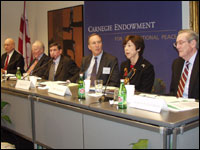
Carnegie hosted the seventh annual seminar of former U.S. trade representatives with presentations on current and future U.S. trade policy issues by Ambassadors Carla Hills, Mickey Kantor, Clayton Yeutter, Charlene Barshefsky, Bill Eberle, and Senator William Brock. Carnegie Senior Associate Sherman Katz moderated the event.

The People’s Liberation Army (PLA) is on course to become the most significant military force in East Asia after the United States within the next decade. Is China's military modernization a growing threat to its Asian neighbors and the U.S.?
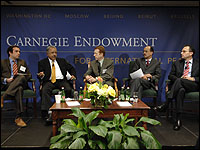
The session, part of the Carnegie Endowment's NEW VISION launch, examines the state of the Arab political reform agenda, what can be expected in terms of political change in the region, and what the U.S. efforts should be to promote regional reform.
A discussion of the national interests and strategies of the U.S., Russia, and China in the region. Has a new Great Game taken shape? What kinds of competition and what degree of cooperation can be expected? How will political and social dynamics within Central Asia affect the plans of the great powers?