Carnegie Moscow Center


As the world's predominant political, economic, and military force, the United States faces a significant challenge in responding to China's rising power and influence, especially in Asia.

Armenia, Azerbaijan, and Georgia weathered the political and economic turbulence of the early 1990s but have yet to develop fully functional market economies.

Since independence, ethno-territorial conflicts have inhibited social, economic, and political development in Armenia, Azerbaijan, and Georgia.

The governments in the South Caucasus too often fail to recognize that state-building projects cannot be completed without a strong foundation in the rule of law and human rights.
At the start of their independence the three republics of the South Caucasus faced two choices: they could build a government whose legitimacy was based on the concept of civic statehood or one based on ethnicity and nationalism.

Western foreign assistance to the South Caucasus has followed an ambitious agenda, with aid aimed at humanitarian aid, political and economic transformation, conflict resolution, and peace building.
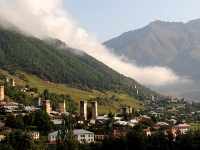
Twenty years after the end of the Soviet Union, the South Caucasus countries can no longer be considered “in transition,” but questions remain about how well they are faring compared to the democratic countries of the European Union or the rising economies of Asia.

The U.S. level of engagement in the South Caucasus is very high and the region as a major priority for Washington.
Twenty years after the end of the Soviet Union, Georgia can no longer be considered a country “in transition.”
After twenty years of independence and state-building, Azerbaijan must determine the best path of future development.