Carnegie Moscow Center

Neither economic nor political reform has produced dramatic change in Arab countries in the last five years, and yet there is continued dynamism and calls for change from within Arab societies.Frustration with formal politics is leading to the creation of less organized protest activities disconnected from any party or movement.
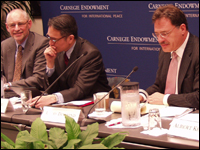
Despite the growing global skepticism of Western-style democracy, citizens across Asia decisively reject authoritarian alternatives such as strong-man rule or military rule.
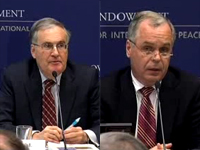
The current financial crisis and resulting credit squeeze raises many questions about how to finance big capital projects. Carnegie hosted a discussion investigating how the financial crisis will affect nuclear reactor construction in the United States.
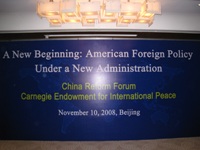
The incoming Obama administration faces a variety of challenges and opportunities in China and Asia more broadly. Many in Asia have assessed Barack Obama's presidential victory as a mandate for a more thoughtful, engaging American foreign policy.
On November 10-12, 2008, the Carnegie Endowment for International Peace and the Foundation of Regional Policy, Tashkent, Uzbekistan, with support by the Central Asia Regional Economic Cooperation Institute of the Asian Development Bank, held an international seminar on “Renewable Energy in Central Asia: Enhancing Food Security and Improving Social and Economic Conditions in Remote Locations.”
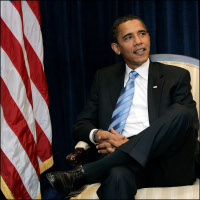
Jessica T. Mathews on Obama's victory, transatlantic cooperation and U.S. foreign policy during the next administration.
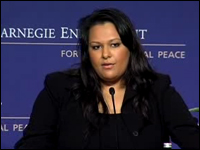
Erosion of U.S. authority in the nonproliferation regime has imperiled U.S. national security and its ability to pursue its security objectives, particularly those related to nonproliferation. The next U.S. administration has an opportunity to reclaim leadership and rebuild the dangerously damaged nonproliferation regime, but only if it better understands the views of non-nuclear-weapon states.
The recent attacks on the U.S. embassy in Sana’a illustrates Yemen’s continuing struggle to fight terrorism. Less recognized are the government’s efforts to develop a “soft” strategy for combating extremist ideology.
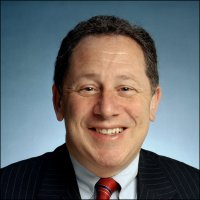
David Rothkopf on how the financial crisis will lead the Obama administration to emphasize multilateralism.
The past three months have been a turbulent time for the Russian Federation, marked by the Russia-Georgia conflict, global financial crisis, and U.S. presidential elections. Carnegie's Nikolai Petrov explains how the government’s response has illustrated that modernization from above will not occur in Russia.