Carnegie Moscow Center

The Chinese Cultural Revolution rocked the social and political foundation of that country over forty years ago. Though I am Gone is the story of the first victim of the Revolution.
Without significant political and financial support, nuclear energy is expected to decline in its share of electricity generation by 2030. The drivers for that support seem to be nuclear energy's contributions to energy security and climate change. Yet nuclear energy won't reduce American dependence on foreign oil, which has been a key concern of many Americans.
A discussion of the superstructure of the nuclear order and the need for U.S. leadership in disarmament and reinvigorated U.S.-Russian arms control cooperation.
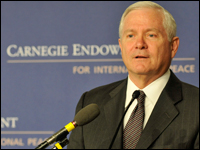
U.S. Secretary of Defense Robert Gates cautioned that the U.S. cannot maintain a credible nuclear deterrent without testing or modernizing its aging stockpile. Gates urged the next U.S. president to engage Russia in new arsenal reduction talks and pointed to the loss of top talent in U.S. weapons laboratories as a major source of concern.

As the international system becomes increasingly multi-polar, Russia and the European Union must find ways to cooperate with one another and engage in dialogue on issues that create strain between them, such as missile deployment in Poland.
The next president must revise Washington's approach to Iran if the United States hopes to halt Iran's enrichment activities and address Iran's role in other issues of critical importance to the United States.
As globalization spread dramatically over the last twenty years, migration expanded less rapidly than either trade or foreign investment. Still, migration remains contentious even as some economists praise it as the fastest route to raising world incomes. The promise of migration, however, is more limited and nuanced.

Both U.S. presidential candidates support the strengthening of strategic cooperation between Russia and the United States, and consider the development of nuclear programs in Iran and North Korea to be unacceptable.
In a Chinese healthcare system where the incomes of hospitals and doctors are often dependent on pharmaceutical sales, the access and affordability of medicine is problematic. Reform is needed, but the nature of that reform is intensely debated.
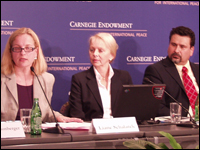
Recent financial and food price crises have forced policy-makers to question conventional thinking on how agricultural markets work, why they sometimes fail, and what role governments should play when they do. To answer some of those questions, the Carnegie Endowment and the Heinrich Boll Foundation co-hosted a panel of experts to discuss sustainable agriculture policies.