Carnegie Moscow Center

The reset represents a substantive change in U.S. foreign policy and U.S.-Russian relations, not just a rhetorical shift. It is an effort to move ahead in search of solutions to vital security concerns.
Russia is fundamentally a European country and, anti-Western tendencies notwithstanding, it has the opportunity to eventually mold its future with its Western neighbors.
Roza Otunbayeva, chairman of the interim government of the Kyrgyz Republic, discussed the recent upheaval in Kyrgyzstan and prospects for the country's political future and relations with the United States, Russia, China, and Europe.
A growing consensus is emerging that direct negotiation with the Taliban leadership is the only option that will lead to a lasting political solution in Afghanistan.
The Middle East has long been a regional battlefield of competing interests among the great powers. In the current international environment, however, the United States, Russia, and, to a lesser extent, China share multiple mutual interests in the region.
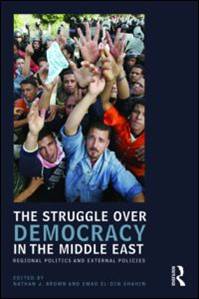
Carnegie's Nathan Brown discusses the experiences of activists, political parties, religious groups, and governments in the Middle East and highlights the difficulties involved in bringing democracy to the region.
In its first six years of existence the Millennium Challenge Corporation (MCC) has performed admirably in the face of both numerous challenges and unrealistic expectations. Its future success, however, is not assured.
Abkhazia has become increasingly dependent on Russia for security, military, and economic investments ever since Moscow recognized Abkhazia’s independence in August 2008.
The recent resignation of President Bakiyev, in the wake of a popular uprising that removed him from power, has given Kyrgyzstan a chance to avoid becoming a failed state.
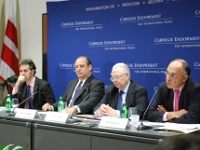
The rapprochement between Armenia and Turkey is in crisis. The protocols on normalization and recognition have not been ratified and a process of great historic and strategic importance is in danger of collapse.